
Labour cost is everything you spend on staff, shown as a share of sales. For Indian restaurants a healthy labour cost is 20 to 30% of sales; above 35% needs attention. The best lever is not cutting people but matching the roster to the busy hours of each weekday.
How to calculate labour cost
| Example outlet | Amount |
|---|---|
| Net sales in a month | ₹10,00,000 |
| 14 staff, salaries and benefits | ₹2,00,000 |
| Overtime and extra helpers | ₹20,000 |
| Labour cost | 22% |
Sales per labour hour
Labour cost tells you the share; sales per labour hour tells you how well each hour of staff time is used, and it works for comparing outlets of different sizes.
Track it by weekday and by hour. Where it drops low, you have more people than guests; where it spikes, service is probably suffering.
Plan the roster around the busy hours
- Look at the last four weeks of sales by weekday and by hour.
- Staff up for the peaks: usually lunch, and dinner from 8 to 11 pm, and weekends.
- Give week-offs on the quietest days, often Monday and Tuesday, not on Saturday and Sunday.
- Use split shifts or staggered start times instead of a full team from opening.
- Plan festival and wedding-season weeks a month ahead.
Habits that keep labour cost in check
- Publish the roster a week ahead, so swaps happen early, not on the day.
- Record attendance every shift, and pay overtime only when it was approved.
- Cross-train: a captain who can run the cash counter covers a sudden leave.
- Keep salary advances and loans recorded against each person, so month-end salary is right.
- Look at vacancies early: an empty post usually ends up as costly overtime.
The hidden cost: people leaving
Every person who leaves costs hiring time, training and slower service for weeks. A fair roster, predictable week-offs and salaries paid on time do more for retention than one-off bonuses.
Roster, attendance and salary in one place
Peasily keeps the roster, attendance, leave, salary, advances and vacancies for every outlet, and shows labour cost beside food cost and net profit on the dashboard, every morning.
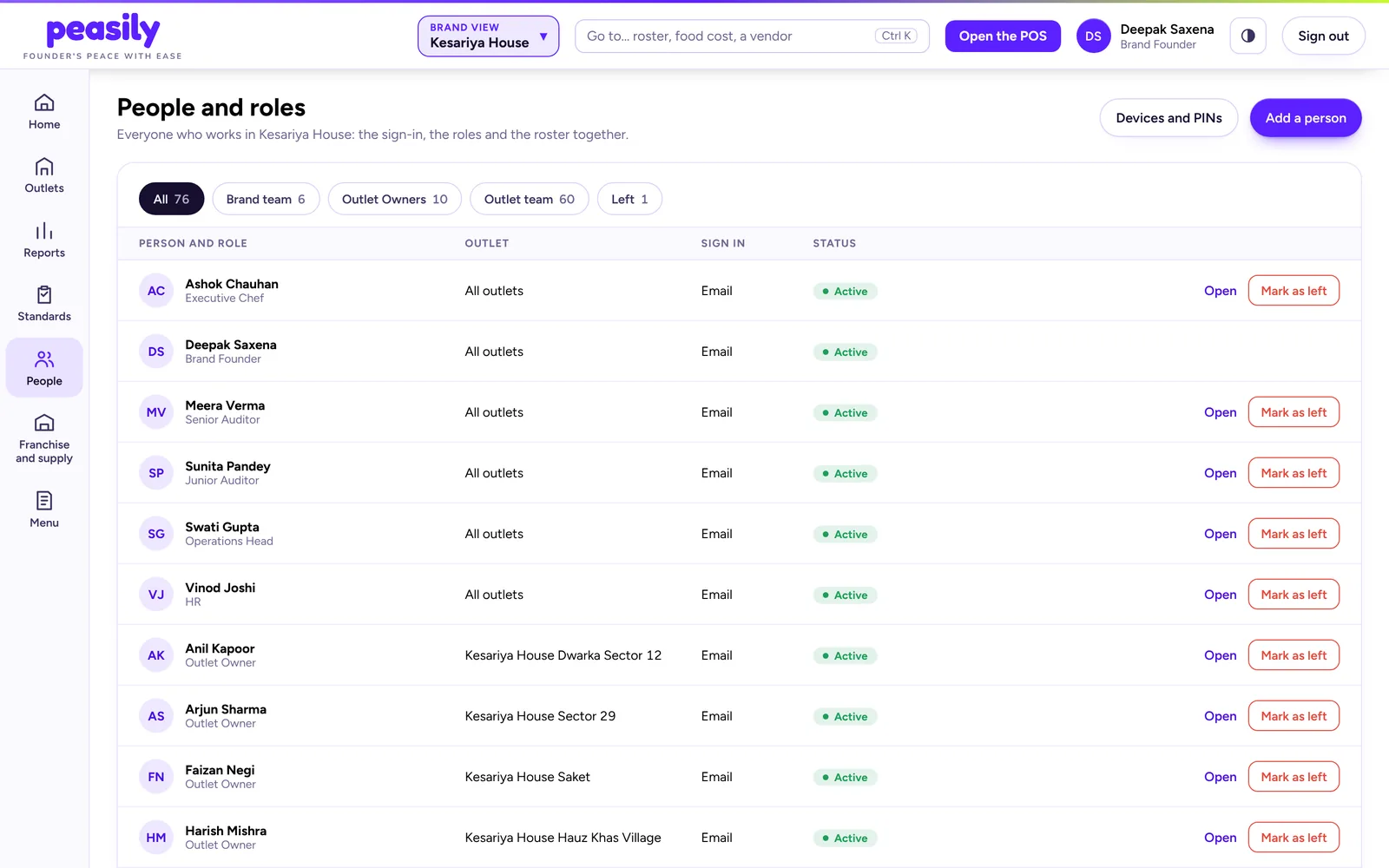
People, roster and salary are in both Peasily packages. Screens from the Peasily demo brand.
Questions
What is a good labour cost for a restaurant in India?
Usually 20 to 30% of net sales, including salaries, overtime, staff meals, accommodation, PF and ESI. Above 35% needs attention.
How should I plan a restaurant staff roster?
Use four weeks of sales by weekday and hour, staff up for lunch, late dinner and weekends, give week-offs on the quietest days, and use staggered start times.
Does Peasily handle roster, attendance and salary?
Yes. Peasily keeps the roster, attendance, leave, salary advances and loans, and vacancies for every outlet, and the outlet team signs in with a PIN on the outlet's own devices.
See your own numbers in Peasily
We'll walk you through it with your real menu and outlets.