
Most restaurants try to grow profit by growing sales. The faster way is to keep more of every rupee you already sell. On an outlet selling ₹10 lakh a month, four everyday levers can lift net profit from about 9% to 14%: ₹50,000 more every month, with the same customers and the same menu.
Sales is the old scoreboard
Two outlets can sell exactly the same and keep very different amounts. Sales and turnover tell you how busy you were. Net profit tells you how well you ran.
| Outlet A | Outlet B | |
|---|---|---|
| Monthly sales | ₹10,00,000 | ₹10,00,000 |
| Net profit | ₹90,000 | ₹1,40,000 |
| Share of sales kept | 9% | 14% |
Four levers that add ₹50,000 a month
Food cost back to the recipe
From 33% to 30.5% of sales, once portions, waste and missing stock show up every day.
Prices on the thin dishes
Raise the price of dishes that sell well but earn little, by a fair amount.
Buy at the lowest price nearby
About 3% less on the ₹3 lakh of ingredients the outlet buys each month.
Less waste, fewer dishes replaced
From 1.2% to 0.6% of sales, once every loss has a reason and an owner.
An example casual-dining outlet with ₹10 lakh of monthly sales. Indian casual dining usually keeps 8 to 12% as net profit.
Five more places profit hides
- Delivery app commissions and ads. Count them in each outlet's profit, not as a separate cost nobody looks at.
- Offers and discounts. Check what each offer really cost against the extra orders it brought.
- Staff hours. Match the roster to the busy hours of each weekday.
- Slow dishes. Dishes that neither sell nor earn hold stock and slow the kitchen.
- Late closing numbers. A profit figure that arrives at month end is too late to change anything.
When sales go up, profit should grow faster
Growth brings hidden costs: extra staff hours, rushed buying and more waste. If sales grow from ₹10 lakh to ₹12 lakh but the margin slips from 14% to 12%, the outlet keeps ₹1,44,000. Hold the margin at 14% and it keeps ₹1,68,000: ₹24,000 more every month from the same growth.
A simple weekly profit routine
- Look at net profit first, then sales, for every outlet.
- Check food cost against the recipes, and find the gap.
- Pick the two dishes that sell most and earn least, and decide on each.
- Compare this week's buying prices with the lowest available nearby.
- Read the waste and replaced-dish list, and fix the top reason.
Profit first, on every screen
Peasily puts net profit first on every dashboard, shows the profit on every dish, finds the lowest price your outlets can get for each item, and gives you the two moves worth the most money this month.
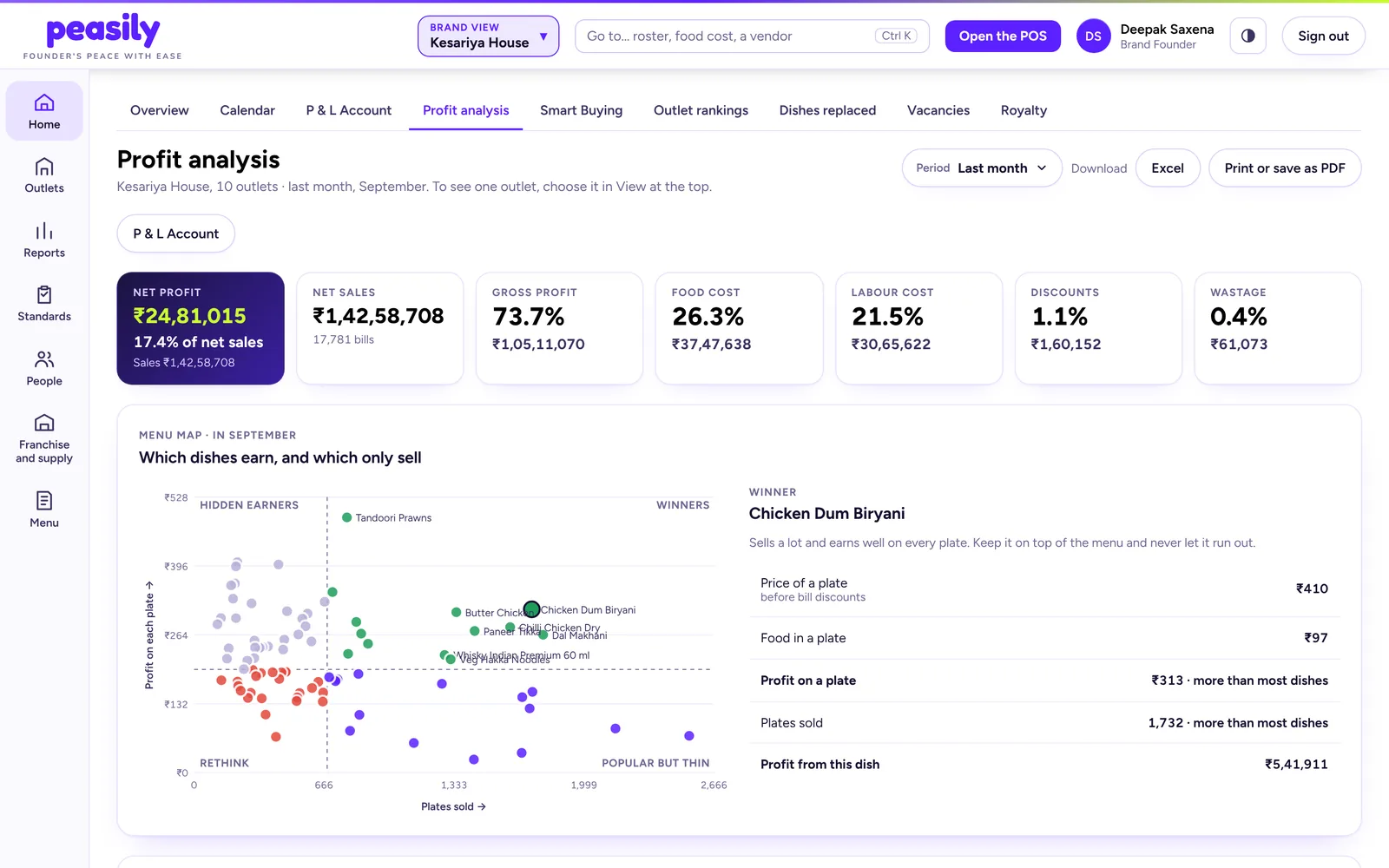
Built for founders who measure profit, not just sales. Screens from the Peasily demo brand.
Questions
How can a restaurant increase profit without increasing sales?
Bring food cost back to the recipe, reprice dishes that sell well but earn little, buy ingredients at the lowest nearby price, and cut waste and replaced dishes. On a ₹10 lakh outlet these four can add about ₹50,000 a month.
What is a good net profit for a restaurant in India?
Roughly 8 to 12% of sales for casual dining, 10 to 15% for quick service and 12 to 18% for fine dining.
Why does profit fall when sales grow?
Costs grow quietly with sales: extra staff hours, rushed buying and more waste. Watching the margin, not just sales, keeps growth profitable.
See your own numbers in Peasily
We'll walk you through it with your real menu and outlets.