
Food cost is the money spent on the ingredients you actually used, shown as a share of food sales. For most Indian restaurants a healthy food cost is 28 to 35% of sales: about 25 to 30% for quick service and 30 to 35% for fine dining. Above 38%, profit is usually leaking somewhere.
How to calculate food cost percentage
Count what you had at the start of the month, add everything you bought, and take away what is left at the end. That is the food you used. Divide it by your food sales.
A worked example
| Line | Amount |
|---|---|
| Opening stock on 1 September | ₹1,20,000 |
| Purchases in September | ₹3,10,000 |
| Closing stock on 30 September | − ₹1,05,000 |
| Food actually used | ₹3,25,000 |
| Food sales in September | ₹10,00,000 |
| Food cost | 32.5% |
Keep food and bar separate. Liquor and soft drinks have very different costs, and mixing them hides problems on both sides.
Work out your food cost
What is a healthy food cost in India?
| Format | Healthy food cost |
|---|---|
| Quick service | 25 to 30% |
| Casual dining | 28 to 33% |
| Fine dining | 30 to 35% |
| Cloud kitchen | 28 to 32% |
| Warning zone, any format | Above 38% |
Rough industry ranges for Indian restaurants. Your own target depends on your menu, prices and city.
Actual food cost and recipe food cost
There are two food costs, and the gap between them is where the money goes.
- Recipe food cost is what your dishes should cost, from the recipe and today's purchase prices.
- Actual food cost is what you really used, from the stock count above.
If the recipes say 30% and the stock count says 32.5%, the 2.5-point gap is ingredients that went somewhere other than a guest's plate. On ₹10 lakh of food sales, that is ₹25,000 every month.
Five reasons food cost runs high
- Portions drift. A little extra paneer or cream on every plate adds up faster than any price rise.
- Prices rise quietly. Suppliers raise rates a few rupees at a time, and menu prices stay where they were.
- Waste is not recorded. Spoilage, over-prep and dishes sent back disappear without a reason.
- Stock goes missing. Without a daily count, there is no way to tell waste from theft.
- Thin dishes sell the most. A popular dish with a high cost pulls the whole percentage up.
How to bring food cost down
- Write a recipe for every dish, with grams, and cost it at today's prices.
- Count the store and kitchen at the same time every week, or every day for costly items.
- Record every waste and every replaced dish, with a reason.
- Compare recipe food cost with actual food cost every week, outlet by outlet.
- Check supplier prices against other nearby suppliers before each order.
- Reprice the dishes that sell well but cost the most.
Food cost, every day, not every month
Peasily works out your actual food cost every day from the kitchen closing, compares it with what the recipes say, and shows the gap in rupees for each outlet, so you see the leak the same week, not at month end.
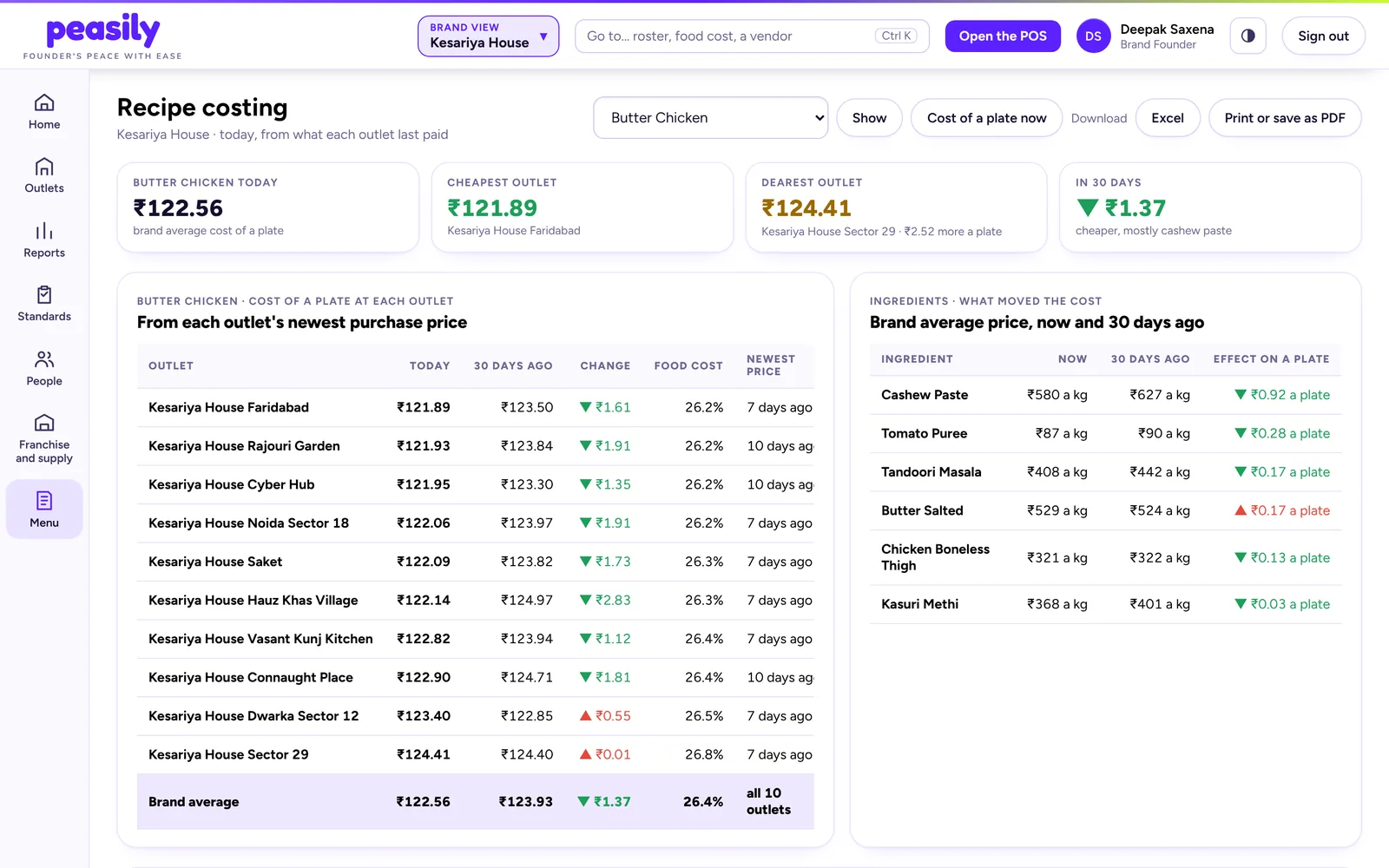
Food cost and recipes are in both Peasily packages. Screens from the Peasily demo brand.
Questions
What is a good food cost percentage for a restaurant in India?
Most Indian restaurants aim for 28 to 35% of food sales: about 25 to 30% for quick service and 30 to 35% for fine dining. Above 38% usually means waste, portions or prices need attention.
Should food cost include drinks?
Keep food and bar separate. Liquor, beer and soft drinks have very different cost percentages, so mixing them hides problems on both sides.
How often should I calculate food cost?
At least once a week. Monthly numbers arrive too late to fix anything. Peasily works it out every day from the closing count and the day's sales.
See your own numbers in Peasily
We'll walk you through it with your real menu and outlets.