
Menu engineering sorts every dish on two questions: does it sell well, and does it leave a good amount after its ingredients? The answers put each dish in one of four groups (stars, plowhorses, puzzles and dogs), and each group has a clear next step.
What is menu engineering?
Most owners know which dishes sell the most. Fewer know which dishes leave the most money after the ingredients are paid for. Menu engineering puts both on one page, so you can decide what to promote, what to reprice, what to rework and what to remove.
You need two numbers for every dish over the same month:
- How many were sold. From your POS.
- What one plate leaves after ingredients. Menu price (before sales tax) minus the cost of one plate at today's prices.
The four groups
| Group | Sells well? | Leaves a good amount? | What to do |
|---|---|---|---|
| Star | Yes | Yes | Protect it. Keep the recipe and portion exact, and give it the best spot on the menu. |
| Plowhorse | Yes | No | Raise the price a little, or lower the plate cost without guests noticing. |
| Puzzle | No | Yes | Make it easier to choose: better name, photo, position, or ask staff to suggest it. |
| Dog | No | No | Rework it or remove it. It takes space, stock and prep time. |
A worked example
Six dishes from one month. Amounts are in your own currency.
| Dish | Sold | Price | Plate cost | Left per plate | Group |
|---|---|---|---|---|---|
| Grilled chicken | 420 | 16.00 | 5.20 | 10.80 | Star |
| Margherita pizza | 610 | 12.50 | 3.00 | 9.50 | Star |
| Beef burger | 520 | 14.00 | 5.60 | 8.40 | Plowhorse |
| Caesar salad | 380 | 10.00 | 2.80 | 7.20 | Plowhorse |
| Seafood pasta | 140 | 19.00 | 6.50 | 12.50 | Puzzle |
| Mushroom soup | 90 | 8.00 | 2.00 | 6.00 | Dog |
Sells well means selling at least 70% of an equal share. Here 2,160 plates were sold across 6 dishes, an equal share is 360, and 70% of that is 252. Anything above 252 sells well.
Leaves a good amount means leaving at least the menu's average per plate. All six dishes together left 19,725 over 2,160 plates, about 9.13 a plate.
The beef burger is the big opportunity. It sells 520 a month; raising its price by 0.75 adds 390 a month with no extra work.
How to do it every month
- Export the number sold for every dish for one full month.
- Cost every plate at this month's purchase prices, not last year's.
- Work out what each plate leaves after ingredients.
- Sort the dishes into the four groups.
- Pick three actions only: one plowhorse to reprice, one puzzle to promote, one dog to rework or remove.
- Check the same dishes again next month.
Keep food and drinks on separate lists. Drinks usually leave far more per item and would push every dish into the wrong group.
Try it on your own numbers: Menu price calculator, free and with no sign-up.
See it every day, not every month
Peasily keeps the cost of every plate up to date from your latest purchases, shows a menu map with the profit on each dish, flags dishes that sell well but earn little, and suggests a fair new price for each.
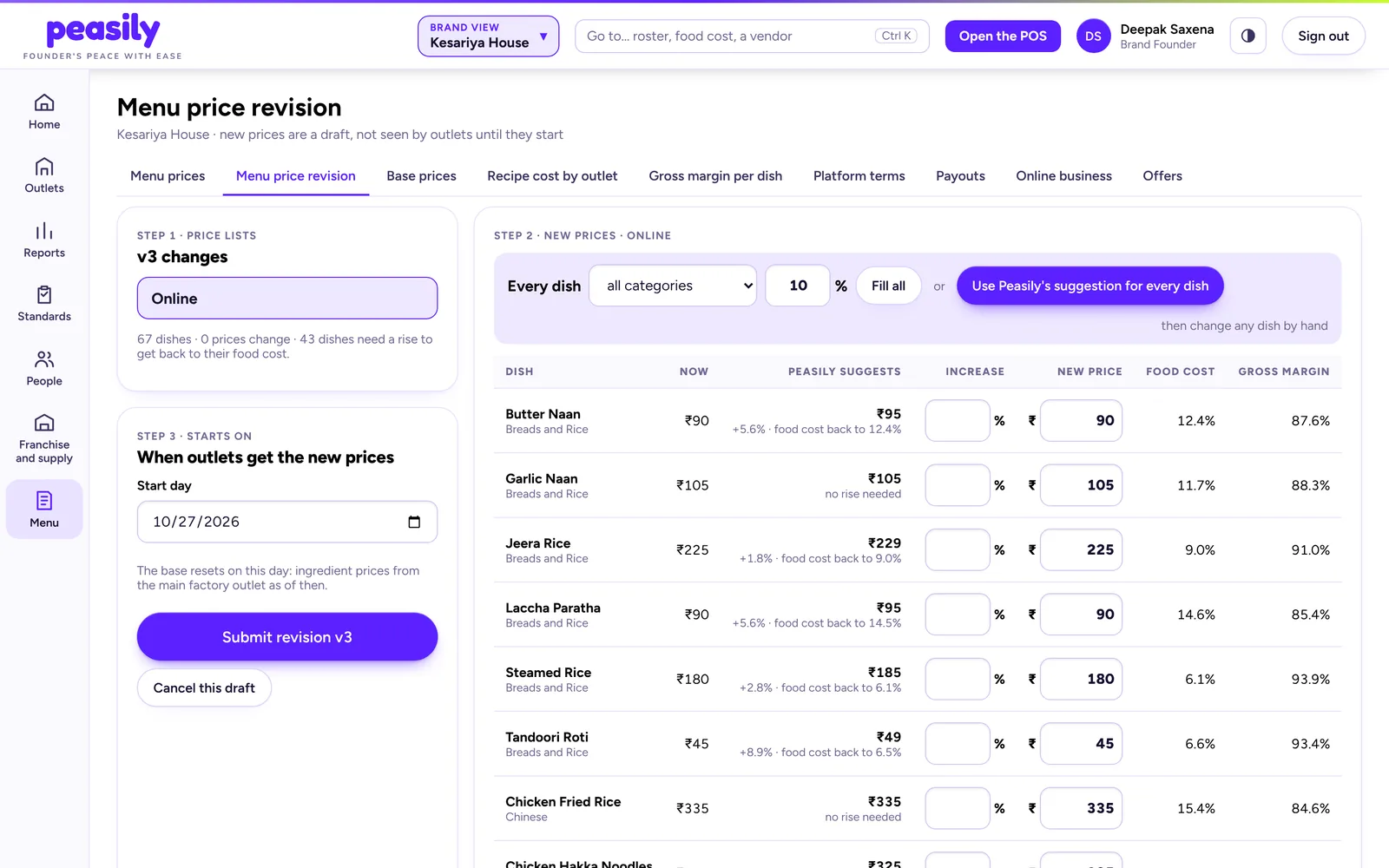
Screens from the Peasily demo brand.
Questions
What is menu engineering in a restaurant?
It is a way to sort every dish by how well it sells and how much it leaves after ingredients, so you know which dishes to promote, reprice, rework or remove.
How often should I do menu engineering?
Once a month is enough for most restaurants, and always after a big change in supplier prices or a new menu.
Should I remove every dog?
Not always. A dish that few people order may still bring a group in, such as the one vegetarian main. Rework it first; remove it only if it has no other job.
See your own numbers in Peasily
We'll walk you through it with your real menu and outlets.